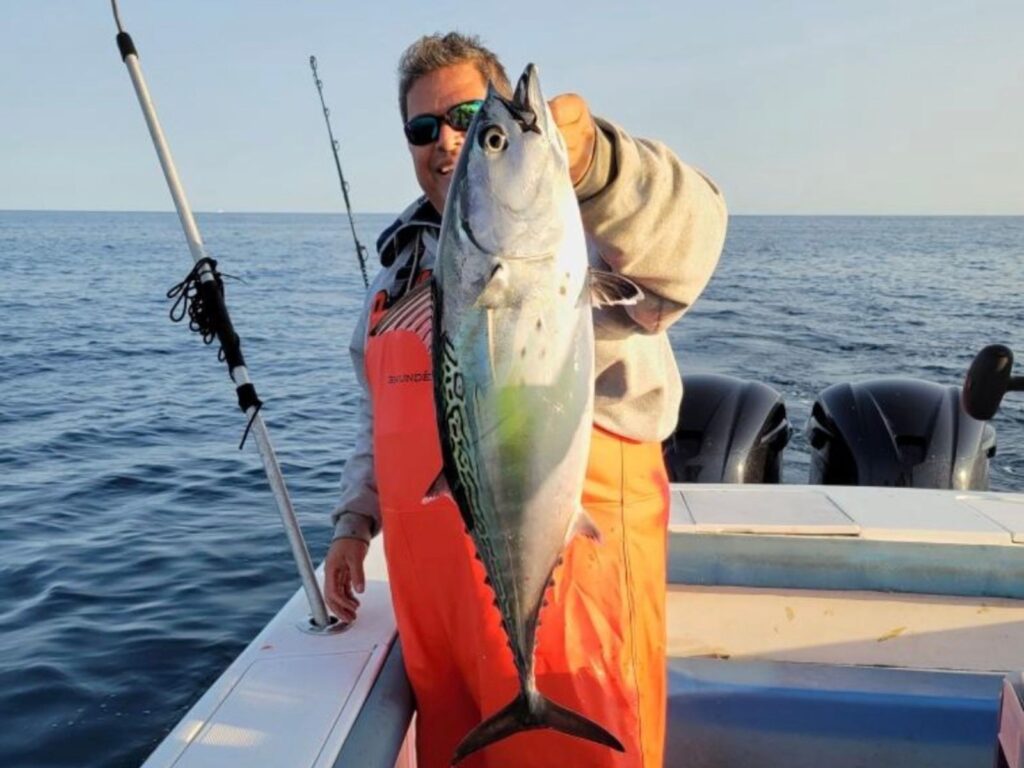
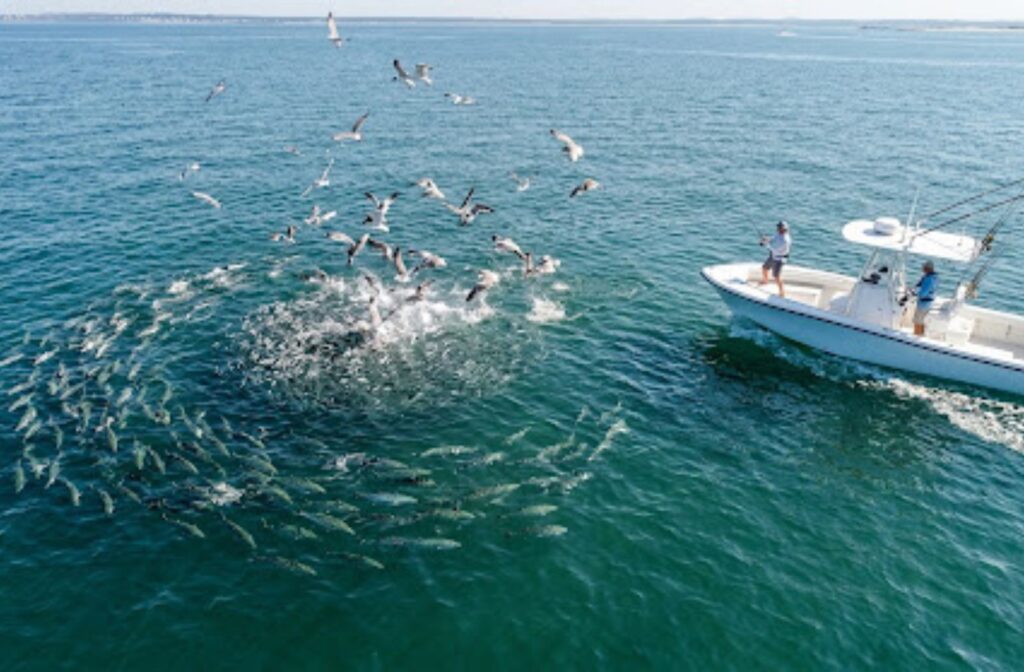
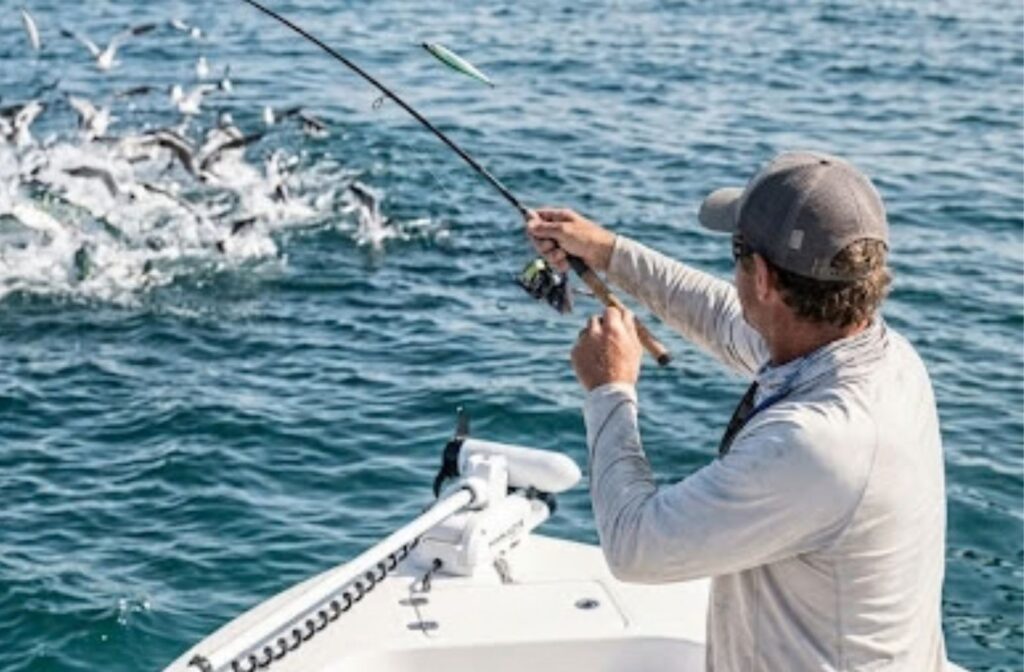
If you’ve ever been false albacore fishing during the fall run and have seen them attacking a school of bait a hundred feet from shore; the water explodes, birds diving, bait scattering and breaching, with Albies behind them in a frenzy.
Many anglers who have connected with a false albacore aka (little tunny), plan their entire fall around them.
False Albacore fishing is fast, frustrating, and addictive in equal measure. Albie’s herd and crush bait balls at speeds that make most inshore species look sluggish, then vanish before you can get a second cast off.
Albies don’t give you many second chances, so this guide sticks to what works. Here’s when the fall run shows up, what the fish are eating, which lures and gear connect, and where to look for them. You’ll also get the regulations and other tips to help you connect with these speedsters. Know before you go.
Table of contents
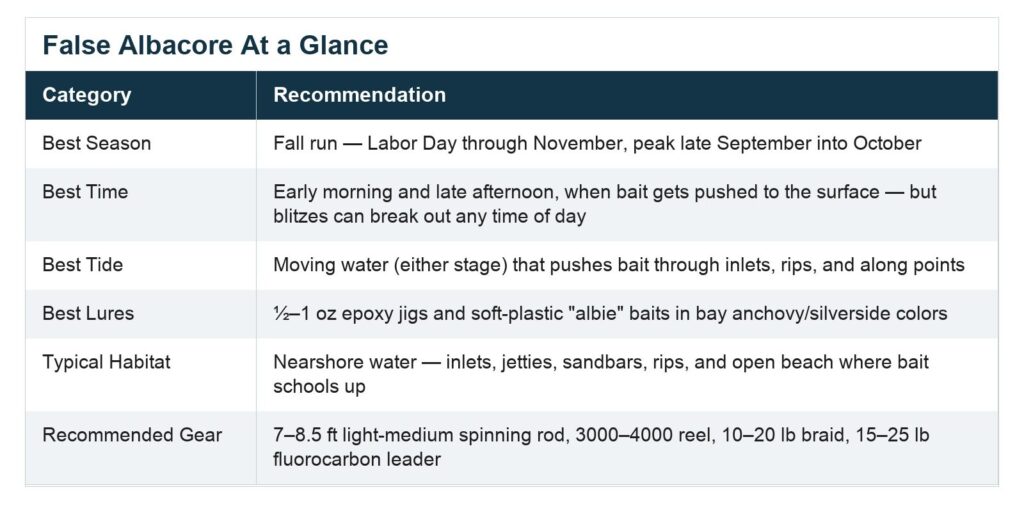
- False Albacore At a Glance
- What Is a False Albacore?
- False Albacore vs. Bonito: Can You Tell Them Apart?
- When Is the Best Time to Catch False Albacore?
- What Do False Albacore Eat?
- Where to Find False Albacore
- Gear for False Albacore Fishing
- Best Lures for False Albacore
- False Albacore Seasonal Strategy
- False Albacore Regulations
- Handling and Release
- A Note on Table Fare
- Frequently Asked Questions
- Last Cast
- Check out The Seafood Cookbook: Sea To Table
False Albacore At a Glance
What Is a False Albacore?
False albacore (Euthynnus alletteratus), also called “little tunny” or simply “albies,” are a small, fast member of the tuna family
False Albacore are usually 8–12 pounds inshore, offshore Albies are occasionally bigger. (see cover pic)
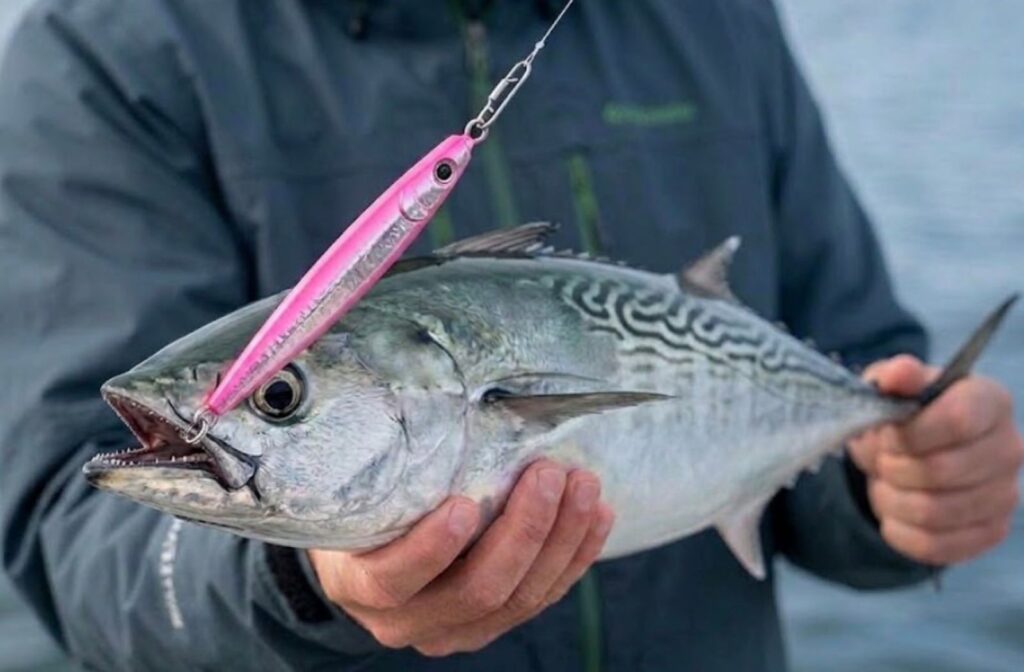
Albie’s are built like torpedoes: dense muscle, a deeply forked tail, and dark wormlike markings on the back that separate them from true albacore and bonito at a glance.
What makes them a favorite target isn’t size — it’s speed, stamina and fight. Pound for pound, few inshore fish pull drag like a false albacore, and they’ll run well into your backing on light spinning or fly gear.
Pro Tip:
Albies are notorious for “looking” at a lure without eating it, especially late in a blitz once they’ve keyed in on the exact size and profile of the bait. If they have made themselves visible, but are not eating, downsizing your lure, often a smaller offering will outperform the bigger lures and of course they get manic with a faster retrieve.
False Albacore vs. Bonito: Can You Tell Them Apart?
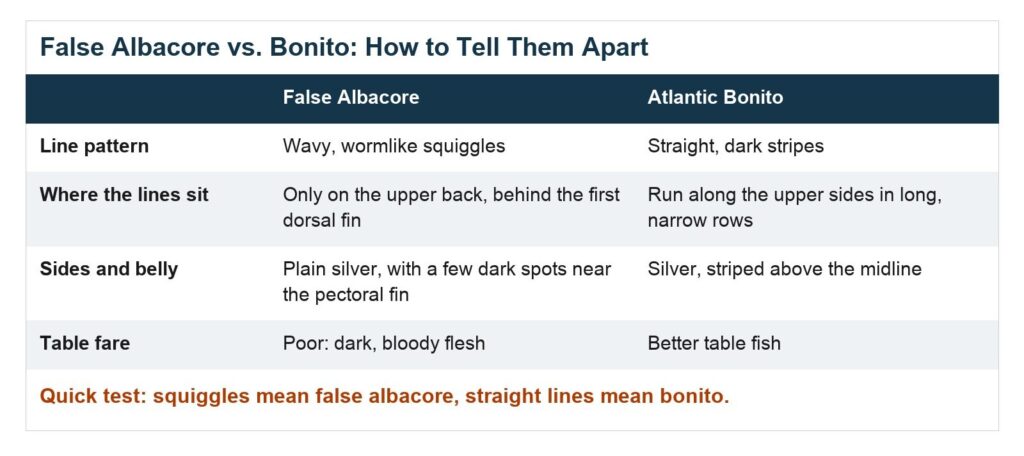
Anglers mix these two up all the time. Check the line pattern on the fishes back first:
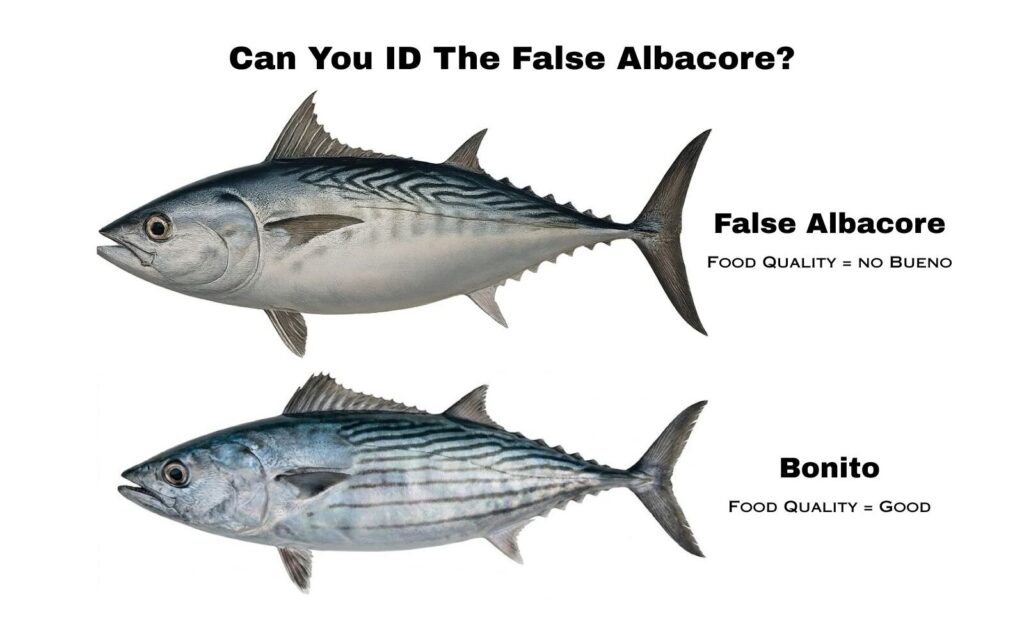
The Acid Test: Squiggled lines mean false albacore, straightish lines mean bonito.
Pro Tip:
Check before you keep a fish. Massachusetts is the only state we found that sets limits (see the regulations chart below).
When Is the Best Time to Catch False Albacore?
False albacore are a predominantly a fall species across the Northeast and Mid-Atlantic. They move North and offshore in Summer, then push back into nearshore water as water temperatures ease in late summer, early fall, following bait into inlets, sounds, along beaches, and around structure.
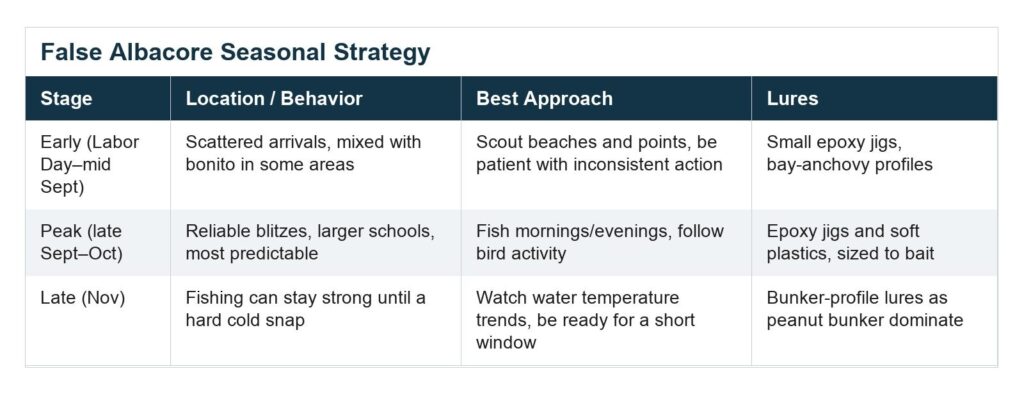
• Labor Day–mid September: first arrivals, action can be inconsistent
• Late September–October: peak of the run, most reliable blitz activity
• November: fishing can stay strong until a hard cold snap pushes both bait and albies out
Because they’re chasing bait, not a calendar, the exact start and finish shifts year to year with water temperature and bait movement — treat the dates above as a range, not a guarantee.
Strategy:
Albies tend to show in the same general areas day after day once a bait school sets up in a location.
If you find fish on one outing, that spot is worth checking again before searching elsewhere.
What Do False Albacore Eat?
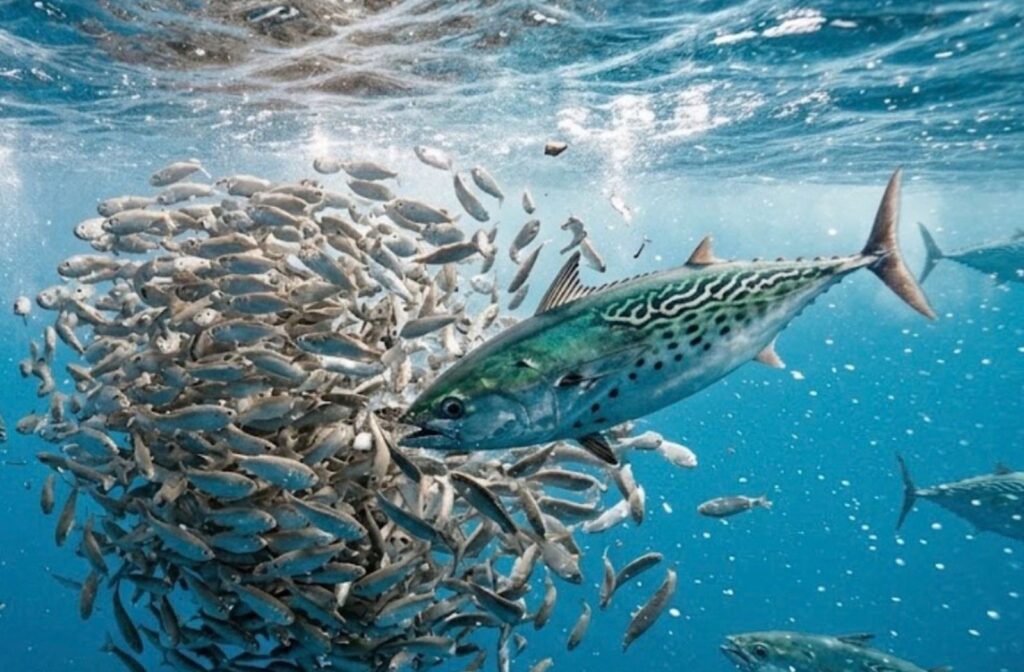
False albacore feed on small schooling baitfish — primarily bay anchovies, sardines, silversides, and peanut bunker (juvenile menhaden) — along with occasional squid and crustaceans. They herd bait to the surface or against structure, then slash through the school in short, violent feeding bursts.
This is the whole key to lure selection: match the hatch.
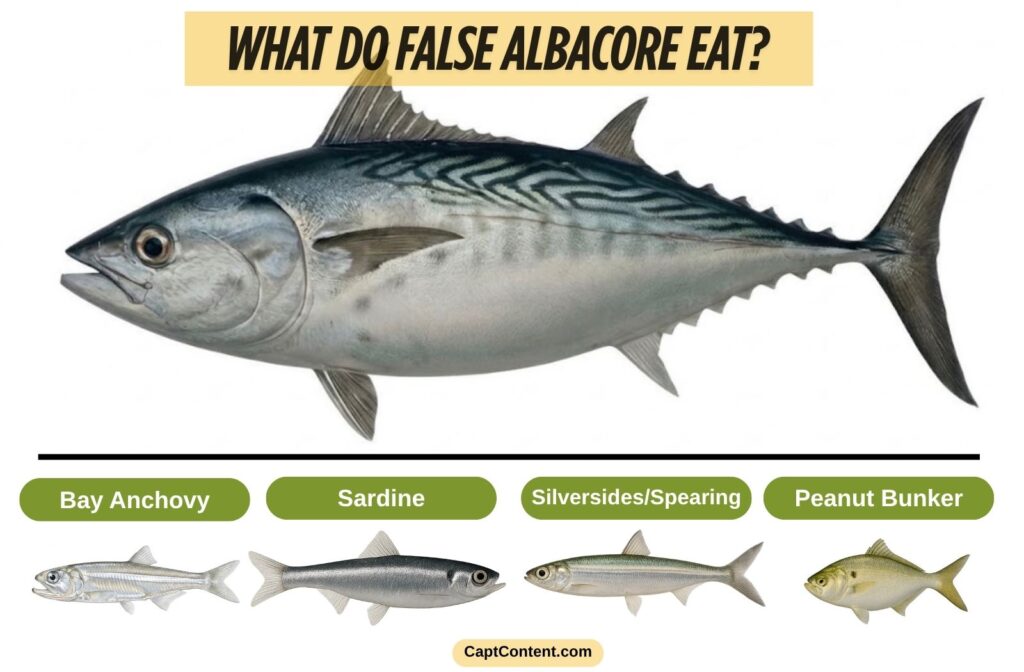
Watch what’s actually getting pushed to the surface during a blitz; observe its size, color, and how it’s moving then pick a lure that imitates that specific profile rather than reaching for whatever worked last time you hooked an albie.
A 2–3 inch bay-anchovy imitation is a safe starting point for Long Island’s early fall run, sizing up as peanut bunker become the dominant bait later in the season.
Where to Find False Albacore
False albacore are a nearshore, structure-oriented fish once they arrive for the fall run. For general tips on reading the water, see our guide to finding great fishing spots.
Where to Look for false albacore:
• Inlets, channel tidal currents which funnel bait through the inlets, these tight areas create a tight passage where albies and other predators stalk and feed.
• Jetties and rock piles, are the ideal ambush points where bait gets pinned against structure and easy prey for false albacore.
• Open beaches and sandbars, especially where diving birds mark a bait school pushed to the surface
• Rips and current seams, denote the underwater moving water currents which concentrates bait even without obvious structure
Montauk, located on the Eastern most tip of Long Island NY, is one of the most consistent false albacore fisheries on the East Coast. False Albacore invade the Long Island waters from the Long Island Sound to Montauk Point throughout the South Shore’s beaches, inlets, jetty’s and rips as the fall migration builds.
Birds are your best spotting tool. Diving terns and gulls almost always mean bait is being pushed to the surface.
A Stealth approach works best run ahead of the direction they are heading to intercept them. Make sure you cut the engine well before you’re on top of the blitz, since albies and the baits spook very easy. The outboard engine’s noise will kills the frenzy faster than other inshore species.
Pro Tip:
A Trolling Motor is ideal as it can approach the pods of breaking Albies with a stealth approach which works best.
Disclosure: This post contains affiliate links. If you buy through them, CaptContent may earn a commission at no extra cost to you. As an Amazon Associate I earn from qualifying purchases.


Gear for False Albacore Fishing
Albies don’t require heavy tackle — they require tackle that casts far and handles a fast, sustained fight.
• Rod: 7–8.5 ft, light to medium power, fast action — long enough for distance casting into a moving blitz


• Reel:
Spinning Reels in the 3000–4000 size with strong, smooth drag are ideal when targeting false albacore. Albies make long, fast immediate initial runs that punish a reel’s drag. The reels listed are moderately priced reels that can battle false albacore.


• Main line: 10–20 lb braid for casting distance and direct feel the braid lines below are proven tough against these speedsters.


• Leader:
Use a 15–25 lb fluorocarbon leader, roughly 2–3 ft, fluorocarbon’s low visibility matters here, since albies have sharp eyesight and will refuse a lure trailing visible mono in clear water


Fly anglers target albies too, typically with 8–9 weight outfits and 300+ yards of backing — the run on a hooked albie is long enough that reel capacity matters as much as rod choice.
Best Lures for False Albacore
This is the section most anglers care about most, and it comes down to two lure families:
Epoxy jigs — ½ to 1 oz jigs with a hard, resin-coated body that casts a long distance and sinks slowly, holding in the strike zone through a long blitz. These remain the standard albie lure because of how far they cast and how closely they mimic a thin baitfish profile.
False Albacore Epoxy Jig assortment (½–1 oz, bay anchovy and silverside colors) Why they work: When cast they covers excellent casting-distance/sink-rate profile albies respond to through most of the fall run.


Soft plastics, (“albie” style baits) — weightless or lightly weighted soft plastics worked erratically at varying speeds.
When fish get finicky late in a blitz and start refusing fast-retrieved jigs, a soft plastic fished with an irregular, twitchy retrieve often draws strikes that a straight retrieve won’t.
Color selection should mimic the prey: white, translucent, and light olive tones for bay anchovies and silversides, spearing; to slightly heavier, bunker-toned profiles as peanut bunker become more common later in the season.
The soft plastics can be fished weightless or weighted, excellent soft-plastic that get an Albie’s attention include, white/bubblegum/and olive-greens.
Why soft plastic baits work. When the frenzy slows down is when to switch to the soft plastics. When fish are make themselves seen but are refusing the faster-moving jig, switch to soft plastic.


Pro Tip:
Carry both lure types pre-rigged and ready. The fastest way to lose a blitz window is re-tying while fish are actively feeding. If you want to swap lures or lure styles have previously tied complete setups. Do not stop to change leaders or tie on lures. Make the switch as fast as possible.
False Albacore Seasonal Strategy
False Albacore Regulations
Size and bag limits subject to change without notice. Please verify all data with your state agency before fishing.
False albacore (“little tunny”) are not covered by NOAA’s federal Highly Migratory Species tuna rules, and almost every Atlantic state has no posted size or bag limit for them.
Massachusetts is the only state we found that sets limits. “None posted” means the species is not listed in that agency’s official regulation table on the date checked, so check with your state before you keep any fish.
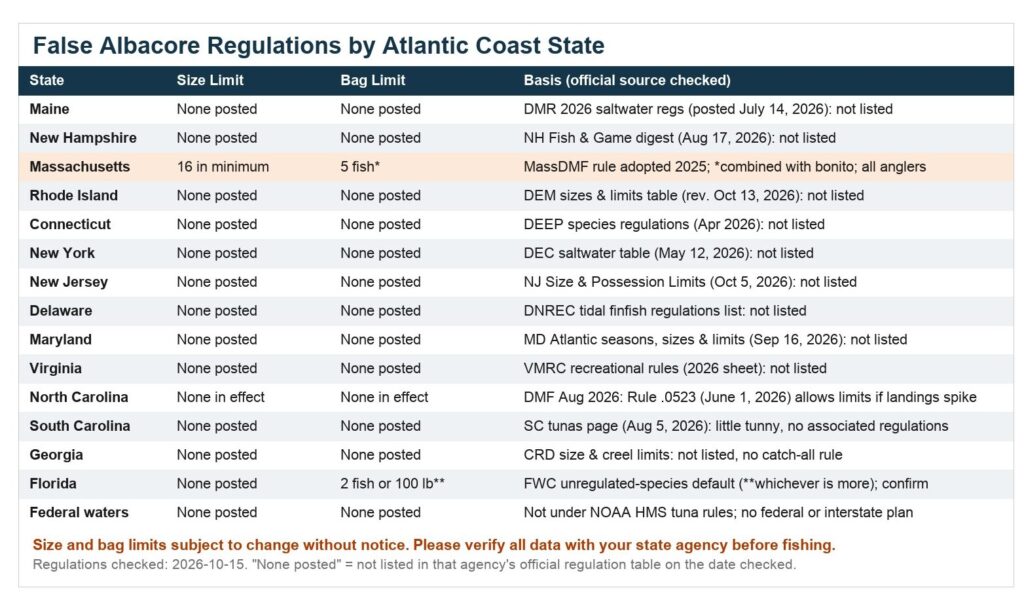
*Massachusetts: has a 5-fish limit it combines both the Atlantic bonito and False Albacore as a common total limit of 5 fish and applies to all anglers.
**Florida: FWC’s default for unregulated species is two fish or 100 pounds per person per day, whichever is more; the FWC page names “bonito,” not little tunny, so confirm with FWC.
North Carolina: Rule 15A NCAC 03M .0523 (effective June 1, 2026) lets the state set limits if landings exceed a threshold; none are in effect.
Regulations Checked:
Regulations as of 2026-10-15. Size and bag limits subject to change without notice. Please verify all data before fishing as regulations can change without notice.
Handling and Release
The overwhelming majority of false albacore caught are released — both because most states have thin or no keep regulations built around harvest, and because of table fare (more on that below). Since they’re built like tuna, a few handling details matter more than they do with most inshore species:
• Minimize air exposure. Albies are high-metabolism, fast-swimming fish, and they don’t tolerate extended time out
• Revive if necessary before release. Hold the fish by the tail and submerged in the water, moving it gently forward and backward letting water pass through the mouth and gills until it kicks off on its own. Consider this CPR for the fish, Don’t release a fish if it is not moving, and or listing to it’s side.
• Use a de-hooking tool or pliers to minimize handling time, and expedite the rebooking process especially with treble-hooked jigs are used and snagged.
A Note on Table Fare
False albacore are not a good food fish.
The flesh is dark and blood-rich, and the flavor is strong enough that most anglers practice catch-and-release rather than keep fish it is not good table fare.
If you’re fishing false albacore, plan on it as a light-tackle sport-fishing fun and excitment target rather than a dinner plan.
Frequently Asked Questions
Can you catch false albacore on bait instead of lures?
It’s uncommon. Albies move too fast and feed too selectively during a blitz for still-fished bait to be effective — nearly all anglers target them with artificials (jigs, soft plastics, or flies) cast directly into feeding fish.
Why won’t false albacore eat my lure even when they’re feeding all around me? This is the single most common albie complaint. It usually means your lure doesn’t match the size or profile of the bait they’re keyed in on, or your retrieve is too fast or not natural and uniform, or your leader is too heavy/visible. Downsizing the lure and vary the retrieve speed are the first two fixes to try.
What’s the best hook size for false albacore lures?
Most epoxy jigs and soft plastics for albies come pre-rigged with hooks sized for the lure, generally in the 1/0–2/0 range. The bigger factor is a sharp, thin-wire hook — albies have hard, bony mouths, and a dull hook results in a lot of missed hooksets.
Is fly fishing or spinning better for false albacore?
Both work well; it comes down to preference and casting distance. Spinning gear generally casts farther with less practice, which helps when blitzes are moving quickly. Fly fishing for albies is prized for the challenge and the fight, but requires more precision to get a fly in front of fast-moving fish.
Do false albacore fight harder than striped bass?
Pound for pound, most anglers who’ve caught both say yes — albies make longer, faster initial runs than a striped bass of similar size, closer to a small tuna than an inshore gamefish.
When does the false albacore run end on Long Island?
It varies by year with water temperature, but fishing can hold up into November before a sustained cold snap pushes both bait and albies out of the area.
Last Cast
False albacore fishing rewards preparation more than power.
Watch the bait, the birds and match the hatch with your lures during the fall run. Observe what baits actually are getting pushed to the surface.
Keep both an epoxy jig and a soft plastic rigged so you can adapt mid-blitz, and handle every fish you plan to release quickly and carefully. Get those pieces right and the fall run becomes one of the most exciting light-tackle fisheries on the East Coast — get them wrong and you’ll spend a lot of mornings watching fish feed just out of range.
If you’re gearing up for the full fall run, check CaptContent’s striped bass and bluefish coverage — albies, stripers, and blues frequently overlap through September and October, and a single morning on the water can put all three in play.
Check out The Seafood Cookbook: Sea To Table


Leave a Reply